Suffolk County's sandy soils and summer dry spells make traditional lawns a losing battle. Here's how xeriscaping changes the math.
Share:
Summary:
Every August, it happens. The sprinklers run, the water bill climbs, and the lawn still turns brown. You’re not doing anything wrong — you’re just fighting a losing battle against Long Island’s summer dry spells with a yard that was never designed to win it.
Xeriscaping is a different approach. It’s not about giving up on a nice yard. It’s about designing one that doesn’t need constant irrigation to survive. For Suffolk County homeowners dealing with sandy soils, unpredictable summers, and water costs that keep rising, it’s worth understanding what this actually looks like in practice.
Xeriscaping is a landscaping approach that reduces or eliminates the need for supplemental irrigation by using drought-tolerant plants, smart soil preparation, and efficient water management. The term was coined by Denver Water in 1981, which is probably why so many people assume it’s a Southwest concept — all rocks, gravel, and cacti.
It isn’t. The goal isn’t to make your yard look like a desert. It’s to design a landscape that works with your local climate rather than against it. Done well, a xeriscape yard can be dense, colorful, and genuinely attractive — just without the weekly watering schedule and the summer stress.
Long Island gets roughly 45 to 50 inches of rain annually, so the question isn’t whether plants can survive here without irrigation. Most of the right plants can. The question is whether your current yard is set up to take advantage of that rainfall — or whether it’s constantly demanding more.

Suffolk County’s soils tell two different stories depending on where you live. In the South Shore communities and central parts of the county, you’re typically dealing with sandy outwash soils — the kind left behind by glaciers thousands of years ago. They drain fast, which sounds like a good thing until you realize it means water moves through the root zone before grass can use it. You end up watering more frequently just to keep up.
On the North Shore — in towns like Smithtown, Northport, and Huntington — the soils shift toward heavier, clay-influenced moraine deposits. These hold moisture better in spring but can become compacted and hydrophobic in summer heat, shedding water rather than absorbing it. Either way, traditional turf ends up being a high-maintenance proposition across Suffolk County.
The numbers behind conventional yard maintenance are worth sitting with. Research suggests the average homeowner spends about two hours a week on traditional lawn and garden care — that’s more than 90 hours a year. Mowing, edging, watering, fertilizing, pulling weeds, and doing it all over again the following week. Xeriscaping doesn’t eliminate maintenance entirely, but it cuts that time roughly in half.
About 30 to 60 percent of household water use happens outdoors, primarily through lawn irrigation. In a county that sits entirely above the Long Island Sole Source Aquifer — the only drinking water source for 1.5 million people — that’s not just a line item on a bill. It’s a direct draw on a shared resource with no backup. Xeriscaping can reduce outdoor water use by 50 to 70 percent compared to a conventional landscape. For a property with a large irrigated lawn, that’s a meaningful difference in both cost and impact.
Spring is when the contrast between a traditional lawn and a xeriscape yard becomes most obvious. For a conventional turf lawn, spring yard care means aerating, overseeding bare patches, applying pre-emergent weed control, fertilizing, and getting the irrigation system back online. It’s a multi-step process that costs money, takes time, and needs to be repeated every year to keep the lawn from declining.
Lawn spring care for a xeriscape property looks different. The plants we recommend — things like black-eyed Susan, coneflower, native ornamental grasses, lavender, inkberry holly, and fine fescues — are already adapted to Zone 7a and 7b conditions. They don’t need to be coaxed back to life in April. A spring walkthrough to clear winter debris, refresh mulch, and do any light pruning is typically all it takes. No overseeding. No fertilizer program. No irrigation startup.
This matters for Suffolk County homeowners specifically because spring is also when the planning window for the year opens up. If you’re tired of the same cycle — the same expenses, the same Saturday morning routine, the same August disappointment — spring is the right time to think about making a change rather than just repeating the pattern.
A well-designed xeriscape yard also handles Long Island’s variable spring weather better than traditional turf. The wet, cool springs we get here actually help drought-tolerant plants establish deep root systems before summer heat arrives. By July, those roots are reaching moisture that turf grass simply can’t access. That’s why a properly installed xeriscape yard can look genuinely healthy in August when the lawn next door has gone dormant.
The transition doesn’t have to happen all at once, either. Many homeowners start with the areas that demand the most irrigation — a south-facing front bed, a strip along the driveway, a section that never quite recovers from summer — and expand from there. Even a partial xeriscape delivers real savings and noticeably less work.
Want live answers?
Connect with a Rolling Hills Property Services Inc expert for fast, friendly support.
Most of the hesitation around xeriscaping comes down to a handful of concerns that come up again and again. Will it look good? Will it survive Long Island winters? Is it really worth the upfront cost? These are fair questions, and they deserve straight answers.
What follows are the questions we hear most often from homeowners across Suffolk County, answered honestly.

This is the question underneath most of the other questions. Nobody wants to be the house on the block with the yard that looks neglected or half-finished. It’s a reasonable concern, especially in communities where curb appeal matters.
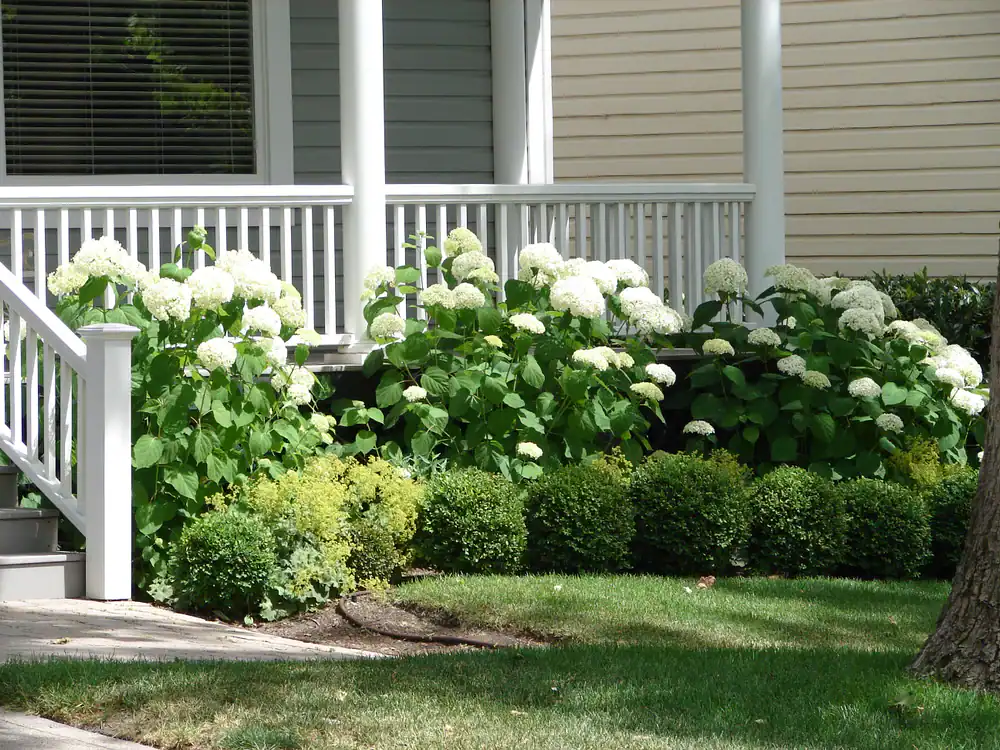
The short answer: a well-designed xeriscape yard doesn’t look like you gave up. It looks intentional. The rock-and-cactus image most people carry around is decades out of date and was never representative of what thoughtful xeriscape design actually looks like in the Northeast.
In Zone 7a and 7b — which covers most of Suffolk County — the plant palette for a xeriscape design is genuinely attractive. Native ornamental grasses like switchgrass and little bluestem give movement and texture through all four seasons. Coneflower and black-eyed Susan bring color from midsummer through fall. Lavender and native fescues provide low-growing ground cover that stays green without irrigation. Inkberry holly adds structure and winter interest. These aren’t placeholder plants — they’re the kind of species that landscape designers actively choose for their visual impact.
Mulching plays a role too. A properly mulched xeriscape bed holds moisture, suppresses weeds, and gives the planting a clean, finished look that reads as well-maintained rather than wild. Research from Virginia Tech and Michigan State University suggests that attractive, well-designed landscaping can increase property values by 5 to 15 percent. A xeriscape yard that looks intentional and cared for contributes to that.
The upfront cost of a xeriscape installation is real, and it’s worth being honest about it. Professional xeriscaping typically runs in the range of $5 to $20 per square foot depending on yard size, plant selection, soil preparation, and whether hardscaping elements like pathways or gravel areas are included. For a full yard transformation, the total investment can be significant.
What changes the math is the long-term picture. A study from North Carolina State University tracked a xeriscape renovation and found that an investment of $1,245 generated combined annual savings of $349.48 through reduced water bills, lower sewage costs, and reduced maintenance expenses. That’s a full return on investment in under three years — and the savings continue every year after that.
For Suffolk County homeowners, the savings case is actually stronger than national averages suggest. Long Island water rates are among the higher rates in the region, and the combination of sandy soils, summer dry spells, and a long growing season means traditional lawns here require more irrigation than they would in many other parts of the country. The baseline cost you’re reducing is higher, so the savings are proportionally larger.
There’s also the maintenance cost side of the equation. If you’re currently paying for regular lawn care — mowing, fertilizing, aeration, overseeding — a xeriscape yard reduces or eliminates most of those recurring expenses. The ongoing maintenance profile is lighter, which means lower annual costs and less of your own time.
The honest answer to “is it worth it” is: it depends on your property, your current irrigation costs, and how you value your time. But for most Suffolk County homeowners who are actively irrigating a traditional lawn through the summer, the numbers tend to work out in favor of making the change — especially when the transition is done in phases rather than all at once.
Xeriscaping isn’t a radical idea. It’s just a smarter design for the conditions you’re actually dealing with — Suffolk County’s sandy soils, summer dry spells, and a water supply that every resident in the county depends on. The yards that hold up best in August aren’t the ones that get watered the most. They’re the ones that were designed to need less water in the first place.
If you’ve been thinking about making a change — whether it’s a full yard transformation or just converting the areas that give you the most trouble — the best time to start planning is before the summer heat arrives.
We at Rolling Hills Property Services Inc work with homeowners across Suffolk County, from Smithtown and Northport to Hauppauge and Huntington, on exactly this kind of project. Free consultations are available, and you can reach us by phone at 631-302-9511 or text 631-652-8035 for fast pricing and availability. We’re here Monday through Friday, 9am to 5pm.
Article details:
Share:
Continue learning: