Pruning at the wrong time can cost you next year's blooms. Here's how to get the timing right for every shrub in your yard.
Share:
Summary:
Here’s a mistake that happens every fall across Suffolk County: a homeowner looks at their overgrown lilacs, grabs the pruning shears, and tidies everything up before winter. It feels productive. Responsible, even. Then spring arrives — and nothing blooms. Not a single flower. The plant is fine, technically. But all the buds that were quietly forming for next year’s display? Gone. Cut off in October.
Timing your shrub trimming isn’t just a gardening preference. For some plants, it’s the whole ballgame. We’ve seen this play out across Smithtown, Huntington, and throughout Suffolk County long enough to know exactly what works — and what doesn’t. This guide covers what you need to know by shrub type so you’re not making expensive, invisible mistakes in your own yard.
The single most useful thing to understand about flowering shrubs is this: some bloom on last year’s wood, and some bloom on this year’s new growth. That distinction determines everything about when you should cut them.
If you treat both categories the same way — say, pruning everything in late fall or early winter — you’ll get it right for half your shrubs and completely wrong for the other half. The key is knowing which category each plant falls into before you touch it.
A helpful rule of thumb: if a shrub blooms before mid-June, it’s almost certainly setting those buds on the previous season’s growth. If it blooms after mid-June, it’s flowering on new wood that grew this spring.

Azaleas, rhododendrons, lilacs, forsythia, and viburnum are the shrubs most Suffolk County homeowners are working with in their foundation beds and along property lines. They’re beautiful when they bloom — and they’re also the easiest to accidentally ruin with poorly timed pruning.
All of these plants bloom on old wood. That means the buds for next spring’s flowers start forming in late summer and fall of the current year. If you prune in October, November, or even February, you’re removing those buds before they ever get a chance to open. The plant won’t die. It’ll just sit there in spring looking healthy and green while producing absolutely nothing.
The correct window for these shrubs is immediately after they finish blooming — typically a two-to-three-week period in late spring, somewhere between late April and early June depending on the specific plant and the year’s weather. You want to get in there while the blooms are fading but before the plant starts setting next year’s buds. Miss that window and you’re better off waiting until the following year rather than pruning at the wrong time.
This is one of the most common reasons we hear from homeowners in Smithtown and across Suffolk County that their azaleas or rhododendrons “stopped flowering.” They haven’t stopped. They’ve just been pruned at the wrong time, year after year, until the homeowner assumes something is wrong with the plant.
One more note: rhododendrons in particular are sensitive to over-pruning. Stick to removing no more than a third of the plant’s live growth in any single session. Aggressive cuts on a rhododendron can set it back significantly, and on Long Island’s coastal properties where salt air already stresses these plants, that recovery time matters.
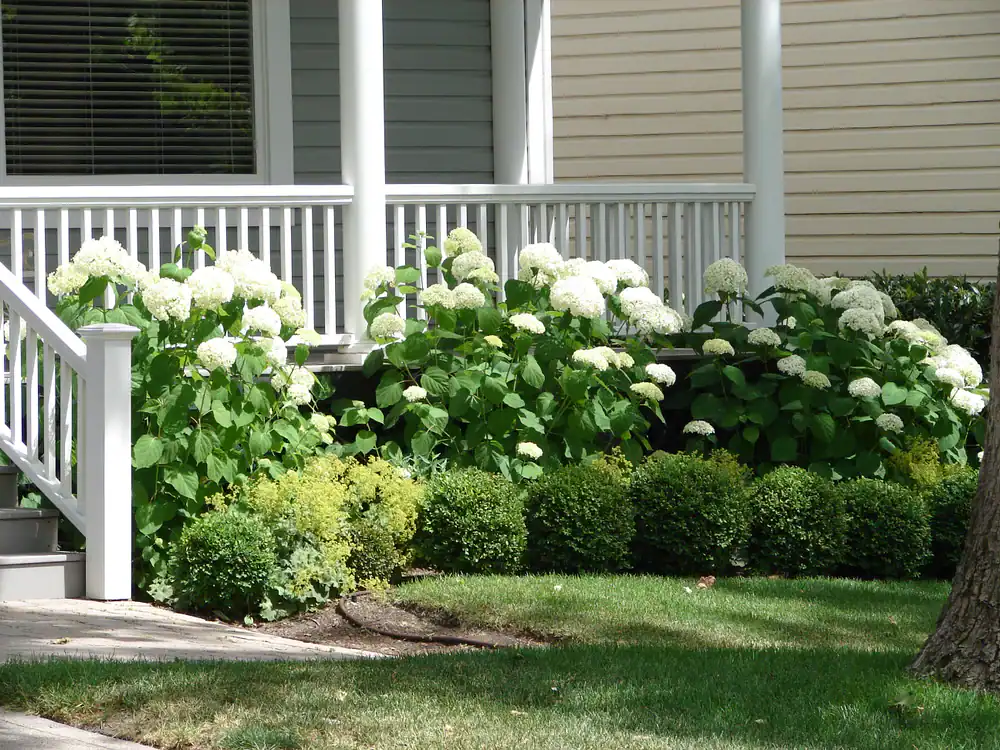
Summer-blooming shrubs operate on the opposite schedule, and they’re actually more forgiving about timing. Hydrangeas (specifically panicle and smooth hydrangea varieties), butterfly bush, and rose of Sharon all bloom on new wood — growth that emerges in spring of the current season. That means late winter to early spring is your window, typically February through early March here in Suffolk County.
Pruning these shrubs while they’re still dormant encourages vigorous new growth once the season starts, and that new growth is exactly what carries the summer flowers. You’re not removing anything the plant needs — you’re clearing the way for it.
The catch is bigleaf hydrangeas, which are common on Long Island and behave more like spring bloomers — they flower on old wood and should be treated accordingly. If you’re not sure which hydrangea you have, a good rule is to watch when and where the blooms appear. If the flowers show up on last year’s woody stems, treat it like an azalea. If new green shoots emerge in spring and the flowers follow those, you can prune in late winter.
For rose of Sharon, late winter pruning actually improves the flower display significantly. These shrubs can get leggy if left alone, and a hard cut back in February or early March produces more compact growth and a better bloom. They’re resilient plants — they handle pruning well as long as you’re not doing it in the middle of summer when the plant is actively growing and flowering.
Suffolk County’s last frost dates typically fall in mid-April for inland areas and a bit earlier along the coast, so late February and March pruning for these shrubs is safe. You’re working within the dormancy window without risking frost damage to the new growth you’re about to stimulate.
Want live answers?
Connect with a Rolling Hills Property Services Inc expert for fast, friendly support.
Shrubs and trees share some timing principles, but trees come with their own set of rules — and a few high-stakes exceptions that matter specifically on Long Island. The general answer for most deciduous trees is late winter, roughly February through March, while the tree is still dormant and before new growth begins. Wounds heal faster when spring growth kicks in right behind the cut, and pest pressure is at its lowest during dormancy.
But “most deciduous trees” isn’t the same as all trees. A few species have timing requirements that aren’t optional — they’re about preventing serious, sometimes irreversible disease.

If you have an apple tree on your Suffolk County property, late winter is your window — specifically February through early April, before the buds break and new growth begins. This timing isn’t arbitrary. Pruning during dormancy reduces stress on the tree, improves airflow and sunlight penetration through the canopy, and significantly lowers the risk of fungal infections that thrive in humid Long Island summers.
The practical payoff is real. Apple trees that are pruned at the right time produce better fruit — more of it, larger, and with fewer disease problems. Trees that are pruned in summer or fall tend to respond by pushing out new growth that can’t harden before winter, leaving the tree more vulnerable to cold damage.
What you’re looking for when you prune an apple tree is the overall structure: removing crossing branches, dead wood, and anything growing toward the center of the canopy that blocks light. The goal is an open, balanced shape that allows air to move freely. You’re not just tidying up — you’re setting the tree up for a better season.
One thing worth knowing: apple trees, like all fruit trees, should follow the one-third rule. Never remove more than a third of the live canopy in a single session. A tree that gets too aggressively pruned at once will put all its energy into replacing that lost growth rather than producing fruit. Spread heavy renovation work over two or three years if needed.
For homeowners in Smithtown, Huntington, or the East End with established fruit trees, getting the pruning timing right in late winter is one of the highest-return maintenance tasks you can do. It’s also one of the easier jobs to get wrong if you’re not sure what you’re looking for in terms of branch structure and cut placement.
Oak trees are the most important timing exception on Long Island, and it’s worth being direct about why: pruning oaks at the wrong time of year can kill them. Not weaken them — kill them.
Oak wilt is a lethal fungal disease that spreads through sap-feeding beetles that are active from April through July. When you prune an oak during those months, the fresh cut attracts these beetles, which carry the fungal spores directly into the tree’s vascular system. The disease spreads fast, and by the time you see symptoms, the damage is often already severe.
The safe window for pruning oaks is November through February, when those beetles are dormant and the tree itself is dormant. This isn’t a preference — it’s the window that arborists and extension services consistently identify as the only low-risk period for oak pruning. Suffolk County and Long Island broadly have large populations of red oaks and white oaks. These are mature, valuable trees that take decades to establish. Losing one to oak wilt because of a summer pruning job is a real outcome, not a theoretical one.
If you have an oak with a broken branch or storm damage during the spring or summer, the right move is to seal the wound immediately with a pruning sealant and schedule any structural work for the dormant window. Nor’easters are a fact of life for Suffolk County homeowners, and post-storm branch damage is common — but reactive pruning on oaks during beetle season is a risk that’s simply not worth taking.
The best time of year to trim trees in general may be late winter, but for oaks specifically, late fall through mid-winter is the target. If you’re not sure whether a tree on your property is an oak or how to identify the right pruning cuts, that’s exactly the kind of assessment that’s worth having a professional handle before you put a saw to it.
The short version: spring-flowering shrubs need to be pruned right after they bloom, summer-flowering shrubs can be cut back in late winter, evergreens have their own windows and hard limits, apple trees do best with a February-to-early-April pruning, and oaks should only be touched between November and February. One calendar, multiple answers — and getting them mixed up has real consequences.
Suffolk County’s climate adds another layer. Coastal salt exposure, sandy soil, and the threat of nor’easters mean your shrubs and trees are already working harder than plants in more sheltered environments. Proper timing gives them the best possible chance to recover, grow, and look the way you want them to.
If you’re not sure what you’re working with — or you’d rather not risk a mature planting on a timing mistake — we’re here to help. Rolling Hills Property Services Inc. is based right here in Smithtown and handles shrub and tree trimming throughout Suffolk County. Text 631-652-8035 for fast pricing and availability.
Article details:
Share:
Continue learning: