Timing your tree and shrub trimming wrong can cost you a full season of blooms — or worse. Here's what actually applies to Long Island properties.
Share:
Summary:
If you’ve ever trimmed your azaleas in early spring and then wondered why they didn’t bloom — this is for you. Pruning timing is one of those things that feels simple until you realize the generic advice you found online was written for a completely different climate, with completely different trees.
Suffolk County has coastal salt spray, active oak wilt, spotted lanternfly, and nor’easters that don’t care about your schedule. The right timing here isn’t just a preference — it genuinely affects whether your plants thrive or struggle. Here’s what you actually need to know.
For most deciduous trees on Long Island, the sweet spot for pruning is late February through early April — while the tree is still dormant and before the buds break. It sounds counterintuitive to do tree work in the cold, but there are real biological reasons why this timing works better than any other season.
When a tree is dormant, it’s not actively pushing energy into new growth. That means any wound from a pruning cut gets the tree’s full attention once spring arrives — healing quickly as new growth surges. Fungal spores and bacteria are also far less active in cold weather, so a fresh cut is significantly less likely to become infected than one made in July.
There’s a practical benefit too. Without leaves on the branches, you can actually see the tree’s structure clearly — which branches are crossing, which ones are dead, which ones are growing toward the house. That visibility makes for better decisions and cleaner work.

If you have red or white oaks on your property — and in Suffolk County, most homeowners do — the timing rules are stricter than for any other tree. Oak wilt killed red oaks across Long Island in recent years, and it spreads primarily through pruning wounds made during warm weather. The beetles that carry the fungus are active from roughly April through October. That’s not a window you want to be making fresh cuts in.
The safe pruning window for oaks is November through February. That’s it. If you’re looking at a dead branch on your oak in June and thinking about cutting it, the better call is to leave it until winter unless it’s a genuine safety hazard. A dead branch isn’t going to spread disease. A fresh wound made in August very well might.
This matters more now than it did five years ago. Oak wilt is an active, documented threat in Suffolk County — not a theoretical risk from somewhere else. A mature red oak on a Long Island property can add $30,000 or more to a home’s value. That’s not a tree you want to gamble with over a scheduling convenience.
The same logic applies to spotted lanternfly, which is now confirmed in Suffolk County. Stressed trees are more vulnerable to infestation. Proper pruning timing that keeps your trees healthy is one of the simplest ways to reduce that vulnerability.
If someone tells you they can prune your oaks any time of year as long as they’re careful, that’s a red flag. Proper technique matters, but it doesn’t override timing when it comes to oak wilt. The beetles find fresh wounds. The only reliable protection is not making those wounds when the beetles are active.
This is where most Suffolk County homeowners make the mistake that costs them a full season of color. The rule that applies to trees — prune in late winter before growth starts — does not apply to spring-flowering shrubs. And the most popular ornamentals in Long Island yards are almost all spring bloomers.
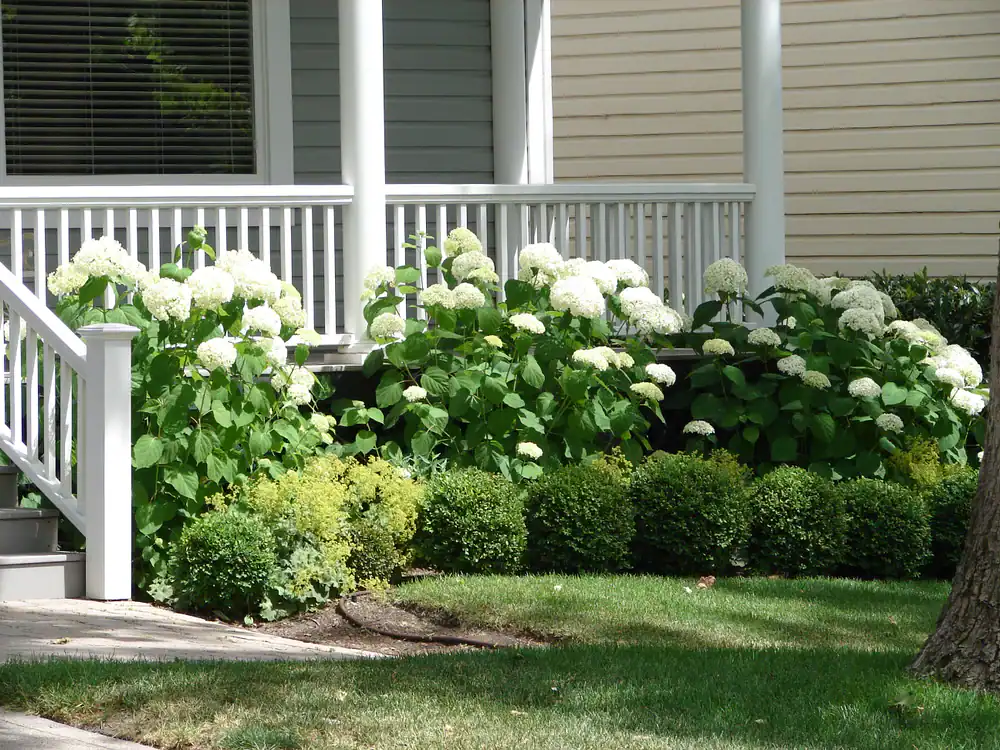
Azaleas, rhododendrons, forsythia, and lilacs all set their flower buds the previous summer. By the time fall arrives, those buds are already formed and waiting. If you prune in October, November, or even February, you’re cutting off next spring’s flowers — every single one of them. The plant won’t be harmed, but you’ll have a shrub full of leaves and no blooms, and you’ll wonder what went wrong.
The right time to prune these plants is immediately after they finish blooming — typically late April through early June depending on the species and the year. You get a short window after the flowers fade but before the plant starts setting next year’s buds. That’s your moment.
Summer-blooming shrubs follow the opposite rule. Butterfly bush, rose of Sharon, and Knock Out roses all bloom on new wood — growth they put out in the current season. For these, late winter or early spring is exactly the right time to prune, before they break dormancy. You’re not cutting off anything they’ve already prepared; you’re just shaping the plant before it starts its new cycle.
Boxwood and arborvitae, which are used constantly as hedges and privacy screens throughout Suffolk County, are evergreens and follow their own schedule. Light shaping works well in late spring after the new growth has hardened off, and you can do a light cleanup trim in early fall. Avoid heavy cuts on arborvitae in particular — they don’t regenerate well from cuts into old wood.
If you’re not sure which category your shrubs fall into, the simplest test is to notice when they bloom. If it’s spring, prune right after. If it’s summer or fall, prune in late winter. When in doubt, a quick consultation before you pick up the shears is worth more than a season of guessing.
Want live answers?
Connect with a Rolling Hills Property Services Inc expert for fast, friendly support.
Fall gets a mixed reputation when it comes to tree work, and honestly, that’s fair. It’s not the ideal time for heavy structural pruning on most deciduous trees, but it’s not a dead zone either. The key is understanding what fall trimming is actually good for versus what’s better left until late winter.
What fall is genuinely useful for is removing dead, damaged, or crossing branches before winter storms arrive. Every October in Suffolk County, homeowners call asking whether their trees will make it through the season. That’s a legitimate concern — nor’easters and winter storms hit Long Island hard, and a weakly attached branch over a roof is a real liability. Removing obvious hazards in October or early November makes sense and doesn’t put the tree at meaningful risk.
What you want to avoid in fall is aggressive structural pruning on trees that haven’t fully gone dormant yet. Large cuts made while the tree is still transitioning into dormancy don’t heal as cleanly, and the fresh wounds going into winter have more exposure time before spring growth can cover them.

Here’s something that doesn’t get talked about in most pruning guides: the timing of when you book matters almost as much as the timing of when the work gets done.
Every year, the same pattern plays out. Homeowners spend summer enjoying their yards. September arrives, the leaves start to turn, and suddenly everyone is thinking about fall cleanup, pre-winter tree work, and overgrown shrubs at the same time. By mid-October, the schedules of every reputable property maintenance company in Suffolk County are packed. Homeowners who waited are either pushed to late November — when the ground is frozen and daylight is short — or they end up booking whoever is still available, which isn’t always who they’d choose if they had more time.
The homeowners who get the best results are the ones who book in August or early September, before the rush. They get their preferred scheduling windows, they have time for a proper consultation rather than a rushed estimate, and the work gets done before the weather turns unpredictable.
For properties in towns like Smithtown, Kings Park, Huntington, and Hauppauge, where mature tree canopies are common and lots are well-established, pre-winter tree work isn’t optional maintenance — it’s how you protect decades of growth before a single storm can undo it.
Yes — but with real caveats, and it depends entirely on what you’re trying to accomplish and which tree you’re dealing with.
Summer is a reasonable time to remove dead or damaged branches on most species. Dead wood doesn’t heal, so there’s no wound closure to worry about, and removing it doesn’t stress the tree the same way a live cut does. If a branch came down in a July thunderstorm and left a jagged break, you don’t need to wait until February to clean that up.
For live structural pruning, summer is generally not ideal for most deciduous trees. The tree is in full growth mode, actively moving resources through its branches. Large cuts interrupt that process, and the combination of summer heat, humidity, and open wounds creates better conditions for disease and pest entry than a clean winter cut would.
Oaks are a hard no for live pruning from April through October — the oak wilt risk is too significant to ignore. This applies to all oaks, including the red oaks that are common throughout Suffolk County’s older neighborhoods.
Some trees — maples, birches, and dogwoods — are worth mentioning separately. These tend to bleed sap heavily when cut in late winter or early spring. It’s not harmful to the tree, but it’s messy and alarming if you’re not expecting it. For these species, summer pruning after the leaves have fully hardened is sometimes preferred over the late-winter window, specifically to avoid the sap flow.
Summer tree work is fine for dead wood removal and emergency cleanup. It’s not the right time for major shaping or structural work on most species, and it’s off the table entirely for oaks. If you’re unsure whether what you’re looking at qualifies as an emergency cut or something that should wait, a quick consultation is always the safer call.
The short version: late winter is best for most trees, right after bloom for spring-flowering shrubs, and fall is fine for dead wood removal and safety work — but not for heavy structural cuts. Oaks follow their own strict window. And if you’re planning fall work, booking early makes a real difference.
The longer version is that every property is different. The mix of species, the age of the trees, the proximity to structures, the history of past pruning — all of it affects what the right call is for your yard specifically. Generic timing rules are a starting point, not a prescription.
If you’re in Suffolk County and want a straightforward look at what your trees and shrubs actually need — and when — we’re happy to take a look. We offer free consultations and written estimates with no hidden fees. You can reach us by phone or text 631-652-8035 for fast pricing and availability.
Article details:
Share:
Continue learning: