Thinking DIY lawn care saves money? The real lawn care equipment cost—plus time, mistakes, and Suffolk County regulations—tells a different story worth understanding.
Share:
Summary:
You’re standing in the lawn equipment aisle, calculator in hand, adding up mowers, trimmers, and spreaders. The numbers look reasonable. You figure you’ll save money handling your own lawn care, maybe even enjoy the weekend routine.
Then reality hits. Equipment breaks down. You burn a section of lawn with too much fertilizer. Your weekends disappear into a cycle of mowing, trimming, and cleanup. Suddenly, that “savings” doesn’t look so clear.
Here’s what actually happens when you compare real lawn care equipment cost against professional service—including the expenses most homeowners don’t see coming.
Let’s start with what you actually need to maintain a lawn yourself. Not the bare minimum that leaves your yard looking neglected, but the equipment required for results you’d actually be proud of.
A basic push mower runs $200 to $400. If you have more than a small yard, you’re looking at a riding mower instead—$800 to $2,000 depending on quality and features. Add a string trimmer for edges and tight spots, another $100. A blower for cleanup, $150. A spreader for fertilizer application, $100.
Right there, you’re at $1,750 to $2,500 before you’ve cut a single blade of grass. And that’s assuming you buy mid-range equipment, not the cheapest options that’ll need replacing in two seasons or the premium commercial-grade models that we use.
The sticker price on lawn care equipment is just the beginning. Most homeowners don’t factor in what comes next, and that’s where DIY costs spiral.
Maintenance averages $220 annually. Oil changes, blade sharpening, air filter replacements, spark plugs, belts—it adds up fast. Sharpen your mower blades twice yearly at $75 per service, and you’re already at $150 just for that. Hit a rock or tree root? Blade replacement or repair easily costs $200 to $300.
Fuel is another ongoing expense. Two gallons per mowing session, 30 sessions per year, and you’re spending around $180 annually just on gas. That’s at current prices—adjust up or down based on your local market.
Storage space matters too. Mowers, trimmers, blowers, and supplies need somewhere to live. If you don’t have a garage or shed, you’re either buying one or watching your equipment deteriorate from weather exposure.
Then there’s the replacement cycle. Quality equipment lasts 5 to 7 years with proper maintenance. Cheaper models might give you 3 to 4 years. Either way, that initial investment isn’t a one-time cost—it’s a recurring expense you’ll face again.
What really gets expensive is mistakes. Apply too much fertilizer and burn your lawn? You’re looking at $300 to $600 to repair or resod damaged areas. Buy the wrong weed control product? That’s $50 to $100 wasted, plus the time spent applying something that doesn’t work. Misdiagnose a lawn problem and treat it incorrectly? Now you’re paying to fix both the original issue and the damage from the wrong treatment.
One homeowner in our area spent over $1,000 in their first year trying to maintain their lawn to professional standards—between equipment, products, and fixing mistakes. That’s more than hiring us would have cost, with none of the guaranteed results.
Walk into any big box store and you’ll find lawn care equipment. Walk onto our crew’s trailer and you’ll see something completely different.
Consumer-grade mowers cut grass. Commercial mowers deliver consistent, clean cuts that promote healthier growth. The difference shows in your lawn’s appearance and health. Our professional equipment runs more efficiently, handles varying conditions better, and lasts significantly longer under heavy use.
The products available to us aren’t even on store shelves. Homeowners get access to Pendimethalin for crabgrass prevention. We use Prodiamine or Dithiopyr—significantly more effective options that come with guarantees. The fertilizer blends you can buy are generic formulas. We custom-blend based on your specific soil conditions, grass type, and seasonal needs.
Calibration makes a massive difference too. We calibrate spreaders to ensure precise application rates. Most homeowners never calibrate anything—they follow the bag instructions and hope for the best. That’s how you end up with striping, missed spots, or overapplication that damages your lawn.
Equipment quality affects your time investment as well. A consumer mower might take you two hours to cut what our crew handles in 30 minutes with commercial equipment. Multiply that time difference across 30 mowing sessions per year, and you’re talking about 45 extra hours spent on a task that could be done more efficiently.
Suffolk County’s specific conditions make this gap even wider. Sandy coastal soil, compacted clay inland, salt exposure near the water, humid summers—these factors demand equipment and products designed for the challenges. Consumer-grade options work adequately in ideal conditions. Our professional equipment and products handle the reality of Long Island lawns.
The expertise matters as much as the equipment. Knowing when to apply what product, at what rate, under what conditions—that knowledge prevents the costly mistakes that turn DIY “savings” into expensive lessons.
Want live answers?
Connect with a Rolling Hills Property Services Inc expert for fast, friendly support.
Here’s what most people don’t count when calculating DIY lawn care savings: the actual time it takes.
Most homeowners spend 2 to 3 hours per week on lawn maintenance during the growing season. That’s not just mowing—it’s trimming, edging, blowing, cleanup, equipment maintenance, and dealing with issues as they arise. Multiply that across the season and you’re looking at 70+ hours annually.
Some areas see even higher numbers. Homeowners in parts of the country with longer growing seasons spend up to 510 hours over their lifetime just mowing. Even in our region, the average person spends roughly 384 hours of their life cutting grass. That’s 16 full days of your life behind a mower.
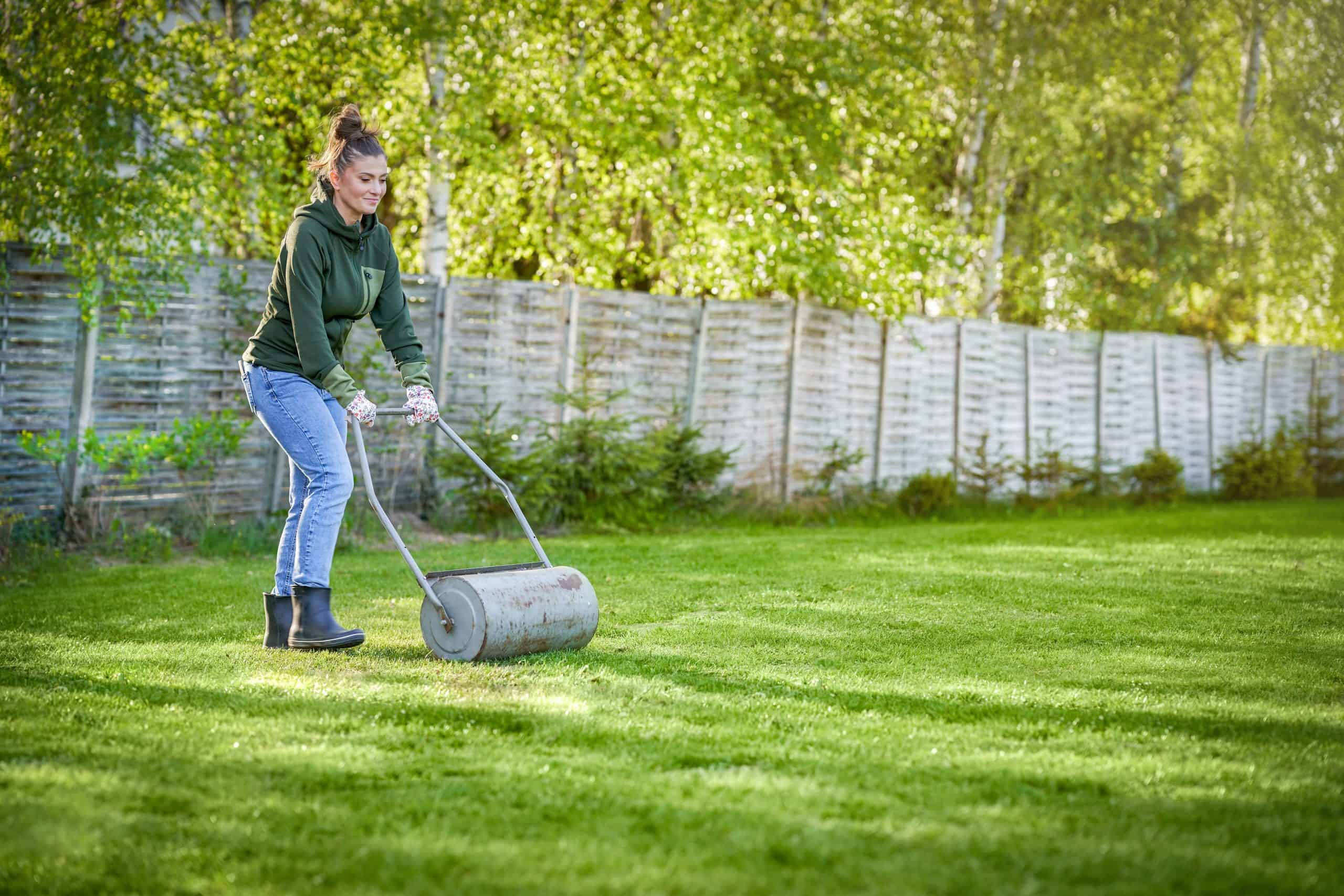
Let’s put a number on it. If you value your time at $15 per hour—a conservative estimate—those 2 hours per mowing session cost you $30 in opportunity cost. That’s what you could be earning or doing instead of pushing a mower.
Add gas at $6 per session, and you’re at $36 per mowing. Multiply by 30 sessions per year, and DIY lawn care costs $1,080 in time and direct expenses. That’s before factoring in equipment depreciation.
Professional mowing for a typical half-acre property averages $45 per cut, or $1,350 annually. The difference? $270 per year. That’s what you’re “saving” by giving up 70+ hours of your time, handling all the equipment maintenance, storing everything, and taking on the risk of mistakes.
Most people don’t think about it this way. They see the $45 service charge and think they’re saving that amount by doing it themselves. But when you account for what your time is worth, the gas you’re buying, the equipment wearing out, and the products you need to purchase, professional lawn service often costs about the same or even less—especially when mistakes enter the picture.
Consider what else you could do with 70 hours per year. Spend time with family. Work on projects that actually interest you. Take on freelance work that pays better than the lawn care “savings.” Rest and recharge instead of spending every Saturday morning behind a mower.
The time investment extends beyond the actual work too. Multiple trips to the store for supplies. Researching which products to use. Trying to figure out what’s wrong when something doesn’t look right. Coordinating lawn care around weather conditions, work schedules, and family obligations. All of that eats into your life without showing up in any cost comparison.
Here’s something that catches DIY homeowners off guard: Suffolk County has strict lawn care regulations, and getting them wrong costs $1,000 per violation.
Fertilizer applications are prohibited between November 1 and April 1. Miss that window and apply too early or too late? You’re risking a four-figure fine. We track these dates precisely because it’s our business to know. Homeowners trying to remember when they can and can’t fertilize often get it wrong.
Timing matters beyond just regulations. Apply fertilizer when soil temperatures are wrong and you waste money on products that won’t work. Treat for crabgrass after it’s already emerged instead of using pre-emergent control? You’ve missed the window and now you’re dealing with an established problem instead of preventing it.
Cool-season grasses that dominate Suffolk County lawns have two peak growth periods—spring and fall. Spring feeding supports root development. Fall fertilization is actually more important for long-term health. Get the timing wrong and you’re either forcing growth when grass wants to rest or missing the opportunity when grass actually needs nutrients.
We monitor soil temperatures, track growing degree days, and adjust application timing based on actual conditions—not calendar dates. We know that mid-April is typically when soil temperatures stay consistently above 55°F in our area, making it the right time to start. We understand that fall applications should happen when grass is actively growing and storing energy for winter, not after it’s already gone dormant.
Licensed lawn care professionals in Suffolk County must complete county-approved turf management courses. We understand local regulations, proper application rates, environmental considerations, and the specific challenges of Long Island lawns. Homeowners are expected to follow the same rules without any of that training or knowledge.
The compliance burden extends to equipment too. Commercial landscapers must register with local townships, maintain proper insurance, and follow noise ordinances that restrict when work can be performed. While homeowners have more flexibility, they still need to navigate the same environmental regulations around product application and disposal.
Missing any of these requirements doesn’t just risk fines—it risks damaging your lawn in ways that cost serious money to fix. Apply the wrong product at the wrong time and you might kill sections of grass, encourage weed growth, or create problems that take months or years to fully resolve.
The real lawn care equipment cost isn’t just what you spend at the store. It’s the time you invest, the mistakes you make, the compliance risks you take, and the results you get compared to what professionals deliver.
For most Suffolk County homeowners, the math works out differently than expected. DIY might save $270 per year—if everything goes perfectly. Factor in one mistake, one equipment repair, or the value of your time, and professional service often costs the same or less while delivering guaranteed results.
You get your weekends back. You avoid the risk of expensive violations. You don’t store equipment or handle maintenance. Most importantly, you get a lawn that actually looks the way you want it to look, maintained by people who understand Long Island’s unique conditions and regulations.
We serve Suffolk County homeowners who recognize that professional lawn care isn’t an expense—it’s an investment in their property, their time, and their peace of mind.
Article details:
Share:
Continue learning: