Real concrete work cost data for Suffolk County homeowners — patios, aprons, sidewalk repair, and what actually drives the price on Long Island.
Share:
Summary:
Every spring, Suffolk County homeowners step outside and see what winter left behind — cracked patios, heaved sidewalk slabs, spalled apron edges. If that’s you right now, you’re not wondering whether to fix it. You’re wondering what it’s going to cost.
The problem is that most cost guides online are built on national averages that have nothing to do with Long Island’s labor market, permit requirements, or soil conditions. We’ve built this page on real project data from Suffolk County jobs — so you can budget accurately and hire with confidence.
The apron is the section of concrete between your sidewalk and the street. It takes a beating — heavy vehicle traffic, road salt, snowplow scraping, and freeze-thaw cycling through the winter months. In Suffolk County, replacing or installing a concrete driveway apron typically runs $1,500 to $3,500, depending on size, thickness, and whether demolition of the existing apron is included.
What makes the apron different from other flatwork is that it sits on public right-of-way, which means most of Suffolk County’s 10 towns require a permit before any work begins. Babylon, Smithtown, Huntington, Islip — each has its own requirements around thickness, reinforcement, and inspection. Skipping that step can mean fines or being required to redo the work entirely.

A few things push apron costs above the base range in Suffolk County, and it’s worth understanding them before you get quotes.
First, removal of the existing apron adds $1.50 to $4 per square foot to the project. If your current apron is thick, heavily reinforced, or bonded to the sidewalk, that number climbs. We have to saw-cut, break out, and haul the debris — that’s real labor and equipment time.
Second, reinforcement matters more on aprons than on patios. Because aprons handle vehicle loads, the industry standard calls for concrete in the 4,500 to 5,000 PSI range, plus rebar or wire mesh reinforcement. That adds roughly $0.50 to $1 per square foot compared to a basic flatwork pour. It’s not padding — it’s what keeps the apron from cracking under the first delivery truck that rolls over it.
Third, Long Island’s road salt is genuinely hard on concrete near the street. Sodium chloride and calcium chloride — both widely used by Suffolk County DPW crews — accelerate surface scaling and spalling, especially on concrete that wasn’t sealed or wasn’t mixed for a freeze-thaw climate. If your apron is already showing surface deterioration, that’s usually why. Properly specified concrete with a sealed surface handles it significantly better.
Belgian block aprons are a popular upgrade in higher-end Suffolk County neighborhoods — Smithtown, Huntington, East Setauket, and similar areas. They cost more than poured concrete, but they’re considered a standard feature in those markets and hold their visual appeal well over time. If you’re in a neighborhood where curb appeal translates directly to resale value, it’s worth asking about the option.
Finally, permit fees and inspection timelines add both cost and scheduling lead time. If you’re hoping to get the work done quickly in spring, factor in that permit processing can add days or weeks depending on the town. We handle permit pulling for you — and we know each town’s specific requirements — which saves you a real headache.
Here’s something a lot of Suffolk County homeowners don’t realize: you’re legally responsible for maintaining the sidewalk in front of your property, even though that sidewalk sits on public right-of-way. A cracked or uneven slab isn’t just an eyesore — it’s a trip-and-fall liability. If someone goes down on a heaved panel in front of your house, the claim can come back to you.
That changes the urgency calculation. Sidewalk repair stops being an optional home improvement and becomes risk management.
For labor, sidewalk repair in Suffolk County runs $70 to $160 per hour depending on the scope. For smaller repairs — a single cracked panel, a lifted edge — you’re typically looking at a few hundred dollars. Full slab replacement for a longer run of sidewalk can reach $3,000 to $8,000 or more, depending on length, thickness, and whether the underlying cause needs to be addressed at the same time.
That last point matters more than most homeowners realize. If a tree root heaved the slab, patching the concrete without addressing the root just means you’ll be back in the same spot in two or three years. If poor drainage is letting water pool under the slab and freeze, the same thing happens. A repair that doesn’t fix the underlying problem isn’t really a repair — it’s a delay.
We use grading lasers and excavators when needed to make sure the sub-base is properly prepared and water is directed away from the surface. It takes more time upfront, but it’s the difference between a fix that lasts and one that doesn’t.
Want live answers?
Connect with a Rolling Hills Property Services Inc expert for fast, friendly support.
For a standard concrete patio, the installed cost in Suffolk County typically falls somewhere between $2,400 and $4,800 for a 20×20-foot surface. Local data for Suffolk County puts the average concrete patio project around $3,602, with a range that can push toward $6,800 or higher depending on finish type and site conditions.
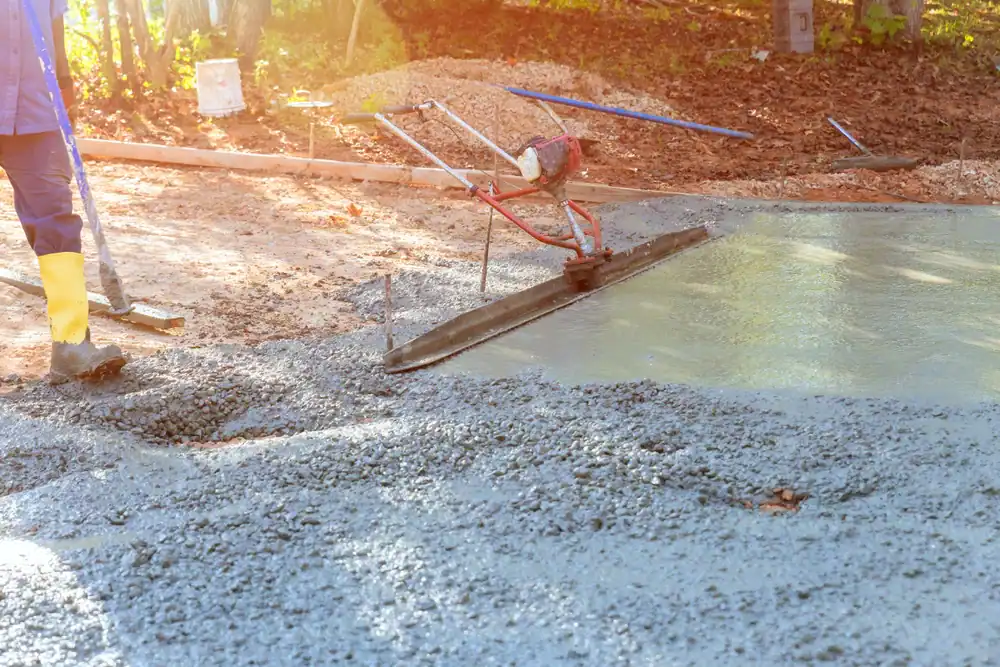
Stamped or decorative concrete costs more — typically $12 to $18 per square foot — because of the additional finishing time and specialized tools involved. Plain flatwork runs closer to $5 to $8 per square foot for placement and finishing, not counting site prep, base material, or removal of existing surfaces.
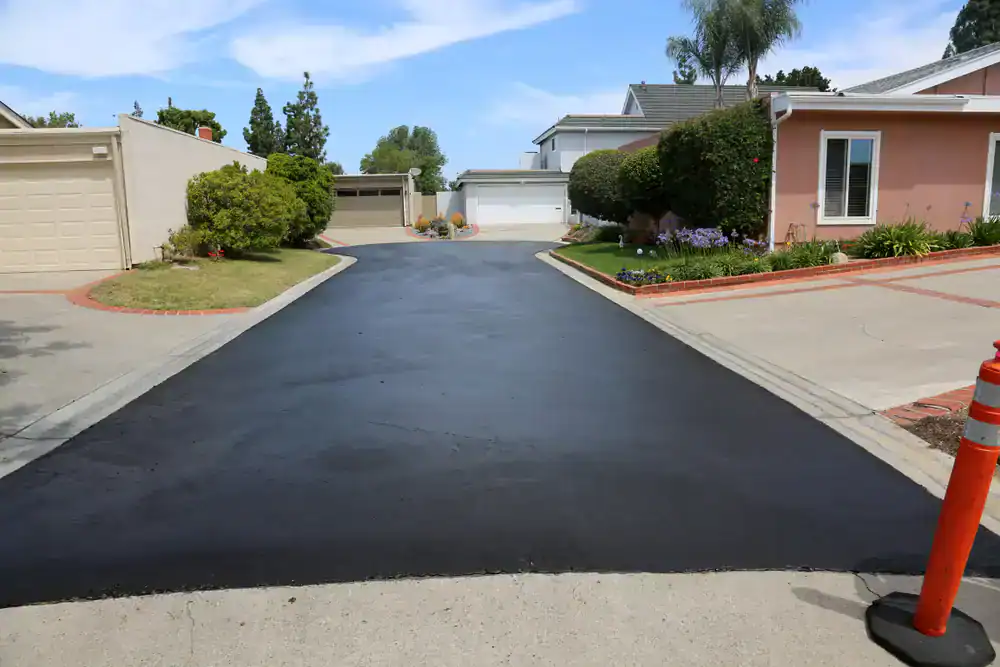
Concrete curbing is one of those details that does more than it looks like it does. It defines property lines, gives your lawn and garden beds a clean edge, and — importantly for Long Island properties — helps manage water runoff by directing flow away from your foundation and hardscaped surfaces.
Curbing is typically priced per linear foot, and the total cost depends on the length of the run, the profile style, and whether any excavation or grading is needed before installation. It’s often added as part of a larger patio or driveway project, which keeps the overall cost lower than scheduling it as a standalone job.
From a practical standpoint, concrete curbing holds up well on Long Island because it doesn’t shift the way plastic or aluminum edging does during freeze-thaw cycles. Plastic edging looks fine in the fall and looks terrible by April. Concrete stays put.
If you’re already investing in a new patio or driveway, it’s worth asking about curbing at the same time. Adding it mid-project is far more efficient than coming back to do it separately — the equipment is already on site, our crew knows the layout, and you avoid a second mobilization cost.
One thing we pay close attention to when installing curbing is drainage integration. Long Island’s sandy, glacially deposited soil drains reasonably well in some areas, but in others — particularly where grading has been disrupted over the years — water pools near foundations and along hardscape edges. Curbing that’s installed without accounting for where the water goes can make that problem worse. We design around it.
Concrete gets a reputation for cracking, but most of that reputation is earned by bad installations, not the material itself. A properly poured concrete surface — right mix, right base, right joints — can last 25 to 50 years for driveways and patios. The Portland Cement Association and U.S. Army Corps of Engineers both document that range. In Suffolk County specifically, a quality install can realistically reach 40 years.
The failures you see — buckled driveways, cracked patios after just a few winters — are almost never a material problem. They’re installation problems. No expansion joints. Inadequate gravel base. Wrong concrete mix for a freeze-thaw climate. Sandy soil that wasn’t properly compacted before the pour. Any one of those shortcuts will show up within a decade.
For Long Island’s climate, air-entrained concrete is the industry standard for exterior flatwork. The mix contains microscopic air bubbles that allow the concrete to flex slightly during freeze-thaw cycles rather than crack under the pressure. It’s not optional here — it’s what separates a driveway that lasts from one that doesn’t make it through its second winter.
Sealing matters too, and it’s the step most homeowners skip. Concrete should be sealed every two to five years to maintain surface integrity, slow moisture penetration, and protect against road salt damage. An unsealed apron or patio in Suffolk County is absorbing salt, water, and road chemicals every winter. Over time, that shows up as surface scaling and spalling — the rough, flaking texture you see on older driveways.
Drainage is the third leg of the stool. Standing water under a concrete slab is one of the fastest ways to shorten its lifespan. Water gets in, freezes, expands, and widens any existing weakness. We use grading lasers on every project to ensure water moves away from the surface and away from your home’s foundation — not because it sounds impressive, but because it’s what makes the work last.
Concrete work cost in Suffolk County is higher than national averages, and the reasons are real — labor costs, permit requirements, material specs for a freeze-thaw climate, and the kind of sub-base preparation that sandy Long Island soil actually demands. A quote that looks low often means something was left out.
The most important thing you can do before hiring is understand what’s included: site prep, base material, permits, removal of the existing surface, drainage grading, and post-project cleanup. A complete project covers all of it. A cheap project usually skips a few.
If you’re ready to get a straight answer on what your project will actually cost, text Rolling Hills Property Services Inc at 631-652-8035 for fast pricing and availability. We’re based in Smithtown and we work throughout Suffolk County — we know the towns, the permit requirements, and the soil conditions that affect every project we take on.
—
**Frequently Asked Questions**
**How long does concrete last on Long Island?** With proper installation — the right concrete mix, a compacted gravel base, expansion joints, and regular sealing — a concrete driveway or patio can last 25 to 50 years. In Suffolk County specifically, a quality install can realistically reach 40 years. The freeze-thaw cycles we get from December through March are hard on concrete that wasn’t poured correctly, but they’re manageable when the job is done right. Air-entrained concrete mixes are the standard for exterior flatwork in Suffolk County for exactly this reason.
**Do I need a permit for concrete work in Suffolk County?** It depends on the project and the town. Suffolk County has 10 towns — Babylon, Brookhaven, East Hampton, Huntington, Islip, Riverhead, Shelter Island, Smithtown, Southampton, and Southold — and each has its own permit requirements. Driveway aprons almost always require a permit because they connect to public right-of-way. Patios on private property may or may not, depending on size and location. We handle permit research and pulling as part of the project so you don’t have to navigate that yourself.
**Is it better to repair or replace cracked concrete?** It depends on what caused the cracking. Small surface cracks can often be repaired cost-effectively. But if the underlying cause — poor drainage, a failed sub-base, tree root pressure, or freeze-thaw heaving — isn’t addressed, the repair is just buying time. In those cases, replacement with proper base preparation is the smarter long-term investment. We assess the root cause before recommending either path.
**How often should I seal my concrete in Suffolk County?** Every two to five years is the general recommendation, and in Suffolk County, staying toward the closer end of that range makes sense. Road salt, coastal humidity, and hard winters accelerate surface wear on unsealed concrete. Sealing slows moisture penetration, protects against salt damage, and extends the life of the surface noticeably.
Article details:
Share:
Continue learning: