Suffolk County winters don't kill plants with cold alone. Find out what's really behind the damage — and which shrubs are most at risk on Long Island.
Share:
Summary:
Every spring, Suffolk County homeowners walk their yards and find the same surprise: arborvitae that looked perfectly healthy in January now showing streaks of brown, boxwood hedges that seem scorched, rhododendrons with curled, papery leaves. The instinct is to blame the cold. But cold isn’t really the problem on Long Island. The problem is what happens when temperatures swing above and below freezing, over and over, through December, January, and February — and your plants can’t keep up. This guide explains why that matters, which plants are most at risk, and what shrub wrapping for winter actually does to protect them.
Long Island sits in USDA Hardiness Zone 7a to 7b. That sounds reassuring — it means our winters aren’t as punishing as upstate New York or New England. But that moderate classification is exactly what makes Long Island winters tricky. Temperatures here don’t drop hard and stay there. They oscillate. A mild day in January sends soil temperatures up; a cold night drives them back down. That cycle repeats all winter, and it’s more damaging to your plants than sustained cold would be.
The mechanism is straightforward. When the ground freezes, roots can’t draw water — but wind, sun, and fluctuating air temperatures keep pulling moisture from evergreen foliage anyway. The result is desiccation: the plant dries from the outside in, even when there’s no visible frost. You won’t see it happening. The damage accumulates quietly until spring, when the brown needles and dead branches finally appear.
Not every plant in your yard needs to be wrapped. But knowing which ones do — and why — makes the difference between a healthy landscape in April and a costly replacement project.
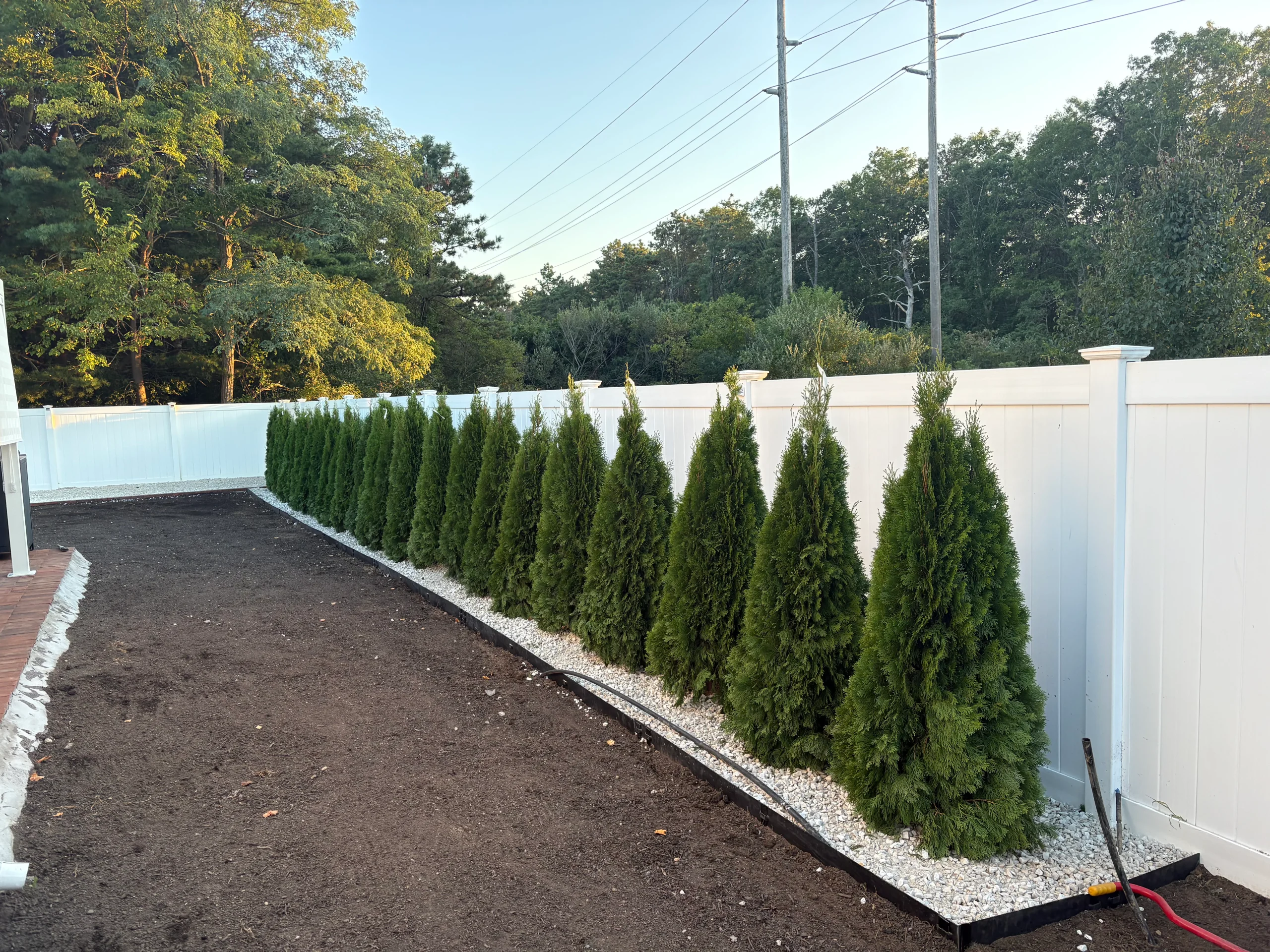
Arborvitae are the most common casualty across Suffolk County. They’re planted everywhere as privacy screens and foundation borders, and they’re genuinely vulnerable. Multi-stemmed varieties are particularly prone to limb breakage under snow and ice loads, and their dense foliage catches wind, which accelerates moisture loss. If you have a row of arborvitae running along your property line or framing your driveway, those plants are working hard all winter in ways you can’t see.
Boxwood is another frequent victim in Long Island yards. It’s a broadleaf evergreen, which means it keeps its leaves through winter and keeps losing moisture through them. Boxwood planted in exposed positions — front-facing borders, open corners, beds near roads — tends to show the worst winter burn. The damage looks like scorching: tan or straw-colored patches that spread from the outer leaves inward.
Rhododendrons and mountain laurel face the same desiccation risk. You may have noticed rhododendron leaves curling tightly on cold mornings — that’s actually a protective response, the plant reducing its surface area to slow moisture loss. It’s a sign the plant is under stress, not just cold.
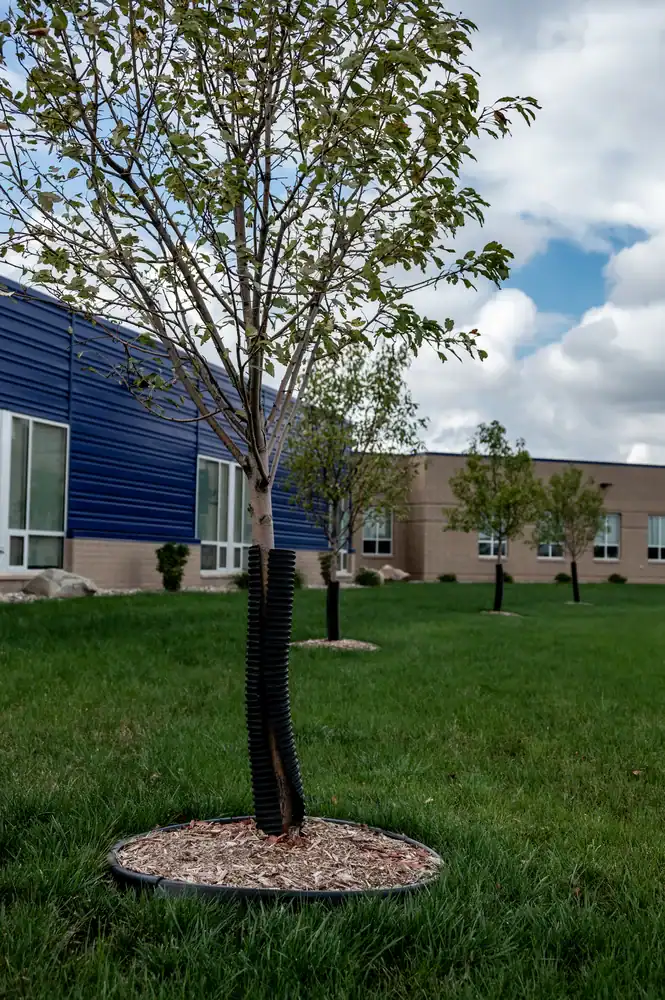
Newly planted shrubs of almost any species deserve extra attention. Their root systems haven’t fully established, which limits their ability to draw water even when the ground isn’t frozen. Most horticulture experts recommend wrapping newly planted specimens for at least their first two winters; for thin-barked trees and shrubs, that protection period may extend to five winters or more.
One detail that often gets overlooked: plants that enter winter already drought-stressed are significantly more vulnerable. If September and October were dry, your plants may have gone into dormancy without the moisture reserves they need. A thorough watering before the first hard frost is one of the simplest things you can do — and one of the most commonly skipped.
Here’s something that doesn’t come up in generic shrub wrapping guides, because it’s a problem specific to places like Long Island: your plants aren’t just fighting cold and desiccation. They’re also fighting salt.
Suffolk County plants face salt from two directions. Coastal storms off Long Island Sound and the Atlantic carry salt spray inland, coating evergreen foliage and accumulating in root zones. Road deicing salt does the same thing along any street, driveway, or parking area that gets treated during winter storms. Salt spray can travel 20 to 30 feet or more from its source, which means foundation plantings, hedges along driveways, and garden beds near the road are all in the exposure zone.
The damage looks almost identical to freeze-thaw desiccation — browning foliage, dieback at branch tips, a scorched appearance — but the mechanism is different. Salt draws moisture out of plant tissue directly and can accumulate in soil to the point where roots struggle to take up water even when the ground isn’t frozen. The two stressors compound each other in ways that make recovery harder.
For plants in salt-exposed positions, the wrapping approach changes. Rather than simply covering the plant for insulation, the goal is to create a physical barrier between the plant and the salt source. Burlap installed between the shrub and the road, driveway, or coastal exposure intercepts spray before it reaches the foliage. It’s a different technique than general winter wrapping, and it’s one that tends to get skipped in DIY approaches because most people don’t realize salt is part of the problem.
If you’ve noticed that the shrubs nearest your driveway always seem to suffer more than the ones in your backyard — and you’ve assumed it was because of exposure or drainage — salt spray is likely a significant factor. The plants in your backyard are protected by distance and structure. The ones up front aren’t.
Want live answers?
Connect with a Rolling Hills Property Services Inc expert for fast, friendly support.
Shrub wrapping is a broader process than most people picture. It’s not just throwing burlap over a plant and calling it done. Done well, it involves the right materials, the right timing, the right technique for each plant’s specific situation — and a plan for spring removal that’s just as important as the installation.
The material matters more than most people realize. Burlap is the standard because it’s breathable. It provides wind protection and some insulation while still allowing air to circulate and moisture to escape. Plastic sheeting — which gets used as a substitute — does the opposite. It traps heat and moisture, creating conditions for fungal disease and bark damage. A plant wrapped in plastic can actually come out of winter in worse shape than one left unwrapped.

Timing is where most DIY wrapping efforts go wrong in one direction or the other.
Wrapping too early — before plants have gone dormant — can trap residual heat and stimulate late-season growth that the plant isn’t ready to sustain. The target window is after the first hard frost, once plants have settled into dormancy, but before a deep freeze sets in. On Long Island, that typically means late October into November, though the exact timing shifts year to year depending on when the season turns.
Spring removal is equally important and gets far less attention. Wraps left on too long into spring trap heat and prevent new growth from emerging properly. They can cause more damage in April than the winter itself caused in January. The right moment to remove them is when the risk of late frost has passed and temperatures are consistently above freezing — but before the plant has started actively pushing new growth. On Long Island, that window usually falls somewhere in March or early April, again depending on the season.
For multi-stemmed shrubs like arborvitae, there’s an additional step that makes a real difference: tying the branches together with coated twine before wrapping. This keeps heavy snow and ice from pulling branches apart or snapping them under load. It’s a small detail that prevents a specific and very common type of winter damage — the kind where you find a large branch splayed out and broken after a wet snowfall.
One more thing worth mentioning: the timing of when you wrap matters, but so does the timing of when you assess. Walking your property in October, before wrapping season, lets you identify which plants are already showing stress, which are in salt-exposed positions, and which newly planted specimens need priority attention. That assessment shapes everything that follows.
Burlap wrapping protects what’s above the ground. Mulch protects what’s below it — and the root zone is where a lot of Long Island’s winter damage actually originates.
A two-to-four-inch layer of organic mulch applied around the base of your shrubs does several things at once. It insulates the root zone against rapid temperature swings, slowing the freeze-thaw cycling that heaves soil and damages shallow roots. It retains moisture, which is critical on Long Island’s sandy glacial soils that drain quickly and hold less water than heavier clay soils. And it moderates soil temperature across the whole winter, reducing the stress that comes from dramatic day-to-night fluctuations.
There’s one mistake that turns mulch from a benefit into a problem: piling it against the stem. Mulch mounded directly against a shrub’s base — sometimes called a mulch volcano — holds moisture against the bark and creates conditions for rot and disease. The correct approach keeps mulch two to three inches away from the stem while still covering the root zone generously.
On Long Island, where soils drain fast and winter winds are persistent, mulching is genuinely one of the most effective things you can do for plant survival. It’s not decorative. It’s functional, and the plants that go into winter with properly applied mulch consistently come out of it in better shape than those without.
We offer mulch installation as part of our seasonal property care — and for most properties, pairing mulch with shrub wrapping gives plants the best chance of coming through winter intact. If you’re investing in protecting your landscape, it makes sense to address both what’s above the ground and what’s below it.
Long Island winters don’t announce the damage they’re doing. By the time you see brown arborvitae or scorched boxwood in April, the window to prevent it has already closed. The good news is that the solution isn’t complicated — it just needs to happen at the right time, with the right materials, and with an understanding of what your specific plants and property are actually up against.
Freeze-thaw cycles, salt spray, sandy soils, coastal winds — these are the conditions Suffolk County plants deal with every year. Wrapping, mulching, and proper timing address all of them, and the difference between doing it well and doing it halfway tends to show up clearly come spring.
If you want a professional set of eyes on your property before winter, Rolling Hills Property Services Inc offers free consultations and straightforward pricing that covers installation, materials, and spring removal together. Reach out by text at 631-652-8035 for fast answers on availability — we’re here Monday through Friday, and we know this county well.
Article details:
Share:
Continue learning: