
Hear from Our Customers

You’ve probably noticed how quickly driveways and walkways deteriorate around here. That’s because Coram’s clay-heavy soil doesn’t drain like normal ground—it holds water, shifts with the seasons, and puts constant pressure on anything sitting on top of it.
When concrete work is done right, you’re looking at 25 to 30 years of solid performance. No resurfacing every few years. No constant patching. Just a clean, stable surface that makes your home look better and actually adds $3,000 to $10,000 in resale value.
The difference comes down to grading and prep. If the base isn’t built to handle how water moves through your specific property, you’ll see cracks within the first freeze-thaw cycle. We use heavy machinery to grade each job based on your property’s drainage patterns, not some cookie-cutter approach that ignores what’s happening six inches below the surface.
We’re based in Smithtown and have been working throughout Suffolk County long enough to know that what works in other parts of New York doesn’t work here. Long Island’s soil composition is different. The weather patterns are different. The municipal codes are different.
We’re licensed, insured, and equipped with the machinery needed to do structural concrete work correctly. That means proper excavation depth, reinforced bases, and drainage solutions that account for clay soil compaction. You’re not getting a crew that learned concrete in another state and hopes it translates.
Every job we do in Coram starts with understanding your property’s grade and how water moves when it rains. That’s not extra—it’s the baseline for work that lasts.

First, we assess your property’s drainage. Clay soil in Coram acts like a barrier, so we need to see where water naturally wants to go and make sure your concrete installation directs it away from your foundation, not toward it.
Next comes excavation and base prep. We dig down to stable soil, then build up a reinforced base using crushed stone that’s compacted in layers. This creates a stable platform that won’t shift when the ground freezes or gets saturated. If your property has drainage issues, we address those now—before any concrete gets poured.
Then we handle the formwork and reinforcement. Steel rebar or wire mesh goes in to give the concrete internal strength. We set forms to the exact grade needed for water runoff, accounting for your property’s specific slope and the street grade at your curb.
The pour and finish come next. We use concrete mixes rated for freeze-thaw cycles and make sure air bubbles are worked out during the pour. The finish depends on what you’re installing—a broom finish for driveways, smooth trowel for walkways, or Belgian block setting for aprons.
Finally, there’s curing and sealing. Concrete needs time to reach full strength. We control the curing process and apply sealant when appropriate to protect against moisture intrusion and surface damage.

Ready to get started?
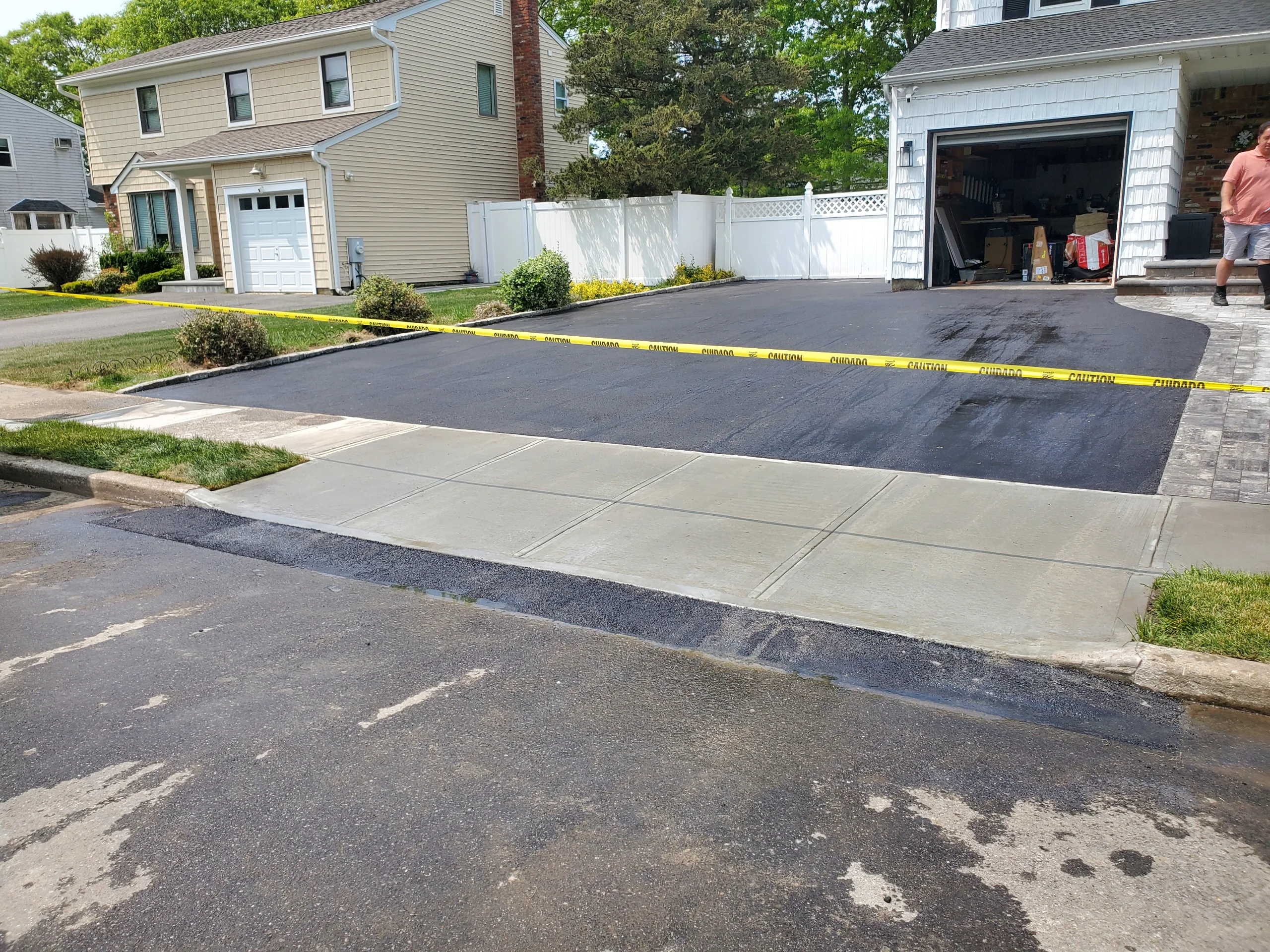
We handle concrete curb installation that meets local code requirements. Every curb cut and apron in Coram has to be concrete—not asphalt—and needs a permit with a dimensioned site plan. We manage that process so you’re not dealing with the town yourself.
Sidewalk repair is another common request. Cracked or uneven walkways aren’t just ugly—they’re liability issues. We remove damaged sections, address whatever caused the problem (usually settling or root intrusion), and pour new concrete that matches your existing work.
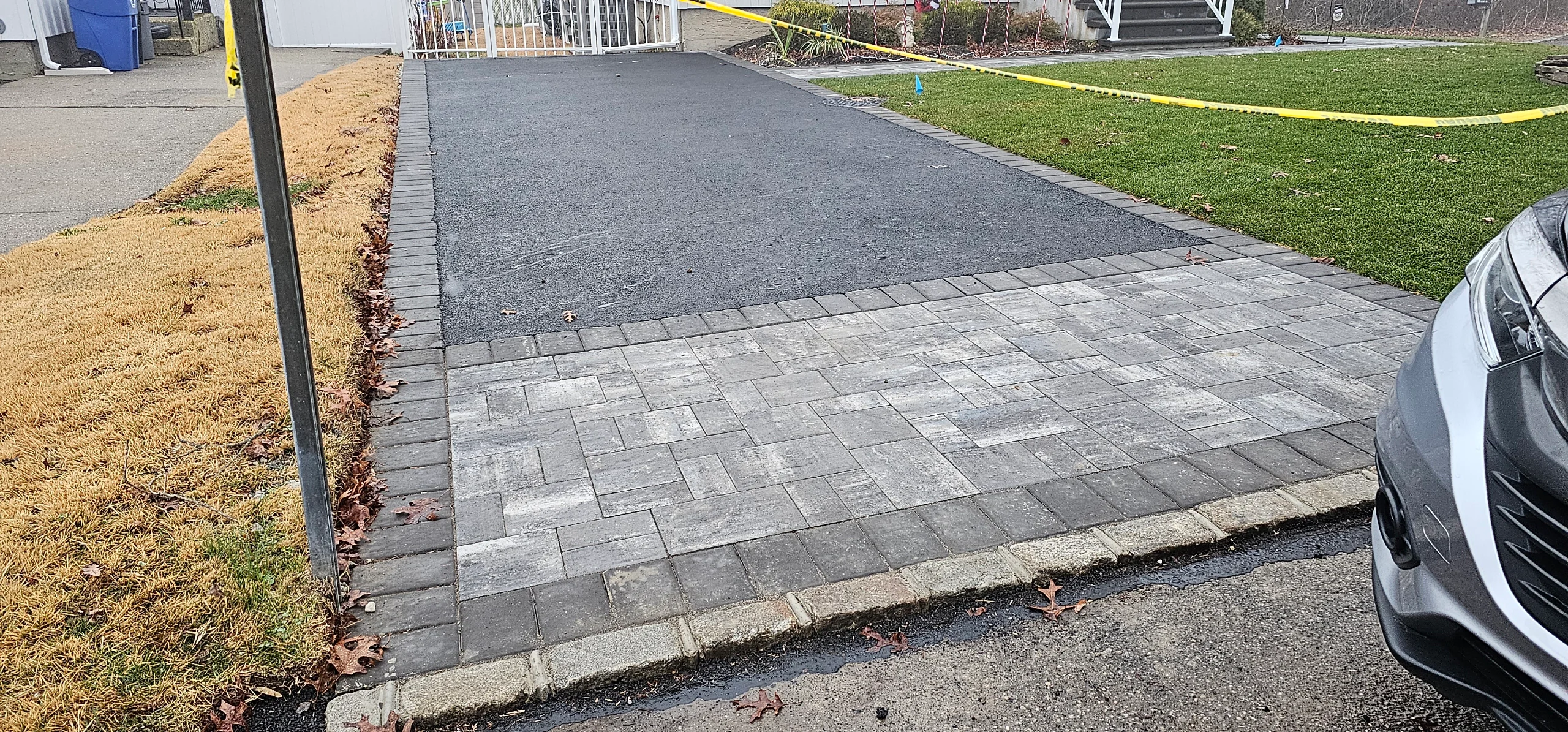
Belgian block driveway aprons are popular in higher-end Coram neighborhoods because they add visual interest and serious durability. A proper apron is built in three layers: reinforced concrete base, mortar bed, and the blocks themselves set in mortar. The whole assembly runs about 12 inches thick and can handle daily traffic for decades.
We also do masonry flatwork—patios, walkways, and other horizontal surfaces that need to be level, properly sloped, and built on a base that won’t move. In Coram, that means accounting for clay soil and making sure water doesn’t pool anywhere near your foundation.
A properly installed concrete driveway in Coram should last 25 to 30 years, sometimes longer. That’s about twice the lifespan of asphalt in the same conditions.
The key word is “properly installed.” If the contractor skips proper base prep or doesn’t account for drainage, you’ll see cracking within a few years. Coram’s clay soil retains moisture and expands when it freezes, which puts pressure on anything sitting on top of it. A driveway built without addressing that will fail early.
Maintenance plays a role too. Sealing your concrete every few years protects it from moisture intrusion and surface damage. But even without sealing, a well-built driveway will outlast most other options available to you.
It usually comes down to poor base preparation or inadequate drainage planning. Coram sits on clay-heavy soil that doesn’t let water pass through easily. When water gets trapped under your driveway, it creates pressure—especially during freeze-thaw cycles.
If the base wasn’t excavated deep enough or the crushed stone wasn’t compacted properly, you’ll get settling and movement. That movement causes cracks. Same thing happens if the contractor didn’t account for where water goes when it rains. Water pooling under concrete will always cause problems.
Another common issue is pouring concrete that’s too thin or not reinforced with rebar or mesh. Concrete needs internal structure to handle the stress from vehicles and weather. Skipping that step to save money just means you’ll be replacing the whole thing sooner.
An apron is the section of your driveway that connects to the street, usually across the sidewalk and up to the curb. In Coram and throughout Suffolk County, aprons must be constructed in concrete—not asphalt—and they require a permit from the town.
The apron takes more abuse than the rest of your driveway because it’s where you transition from street grade to your property grade. That’s why many homeowners choose Belgian block aprons. The blocks add traction, create a clear visual boundary, and they’re extremely durable when set properly in a reinforced concrete base with mortar joints.
A regular driveway can be concrete or asphalt (though concrete lasts longer). The apron is always concrete, always permitted, and always built to municipal specs. We handle both, but they’re technically different parts of your driveway with different requirements.
Concrete driveways in Long Island generally run $12 to $25 per square foot installed, depending on site conditions and whether you want reinforcement or decorative elements. A standard two-car driveway usually falls between $7,200 and $15,000.
Sidewalk repair costs less because you’re working with smaller areas—usually a few hundred to a couple thousand depending on how much needs replacement. Belgian block aprons cost more than standard concrete because of the labor involved in setting each block, but they last longer and add more visual appeal.
The biggest cost variables are excavation depth (which depends on your soil conditions), drainage solutions (if your property has water issues), and whether you need permits or municipal inspections. We give you a clear estimate upfront so you know exactly what you’re paying for and why.
Yes, and we usually have to. Most properties in Coram have some level of drainage challenge because of the clay soil. If we’re tearing out old concrete or excavating for new work, that’s the right time to address drainage before it becomes a bigger problem.
Common solutions include installing French drains along the driveway edge, regrading the base to direct water away from your foundation, or adding catch basins in low spots. The goal is to give water a path to follow so it doesn’t sit under your concrete or pool against your house.
Fixing drainage during concrete installation costs less than dealing with foundation water issues later. Clay soil doesn’t absorb water—it just holds it. If you don’t give that water somewhere to go, it’ll find the path of least resistance, and that’s usually into your basement or under your driveway where it’ll cause cracking.
You need a permit for any concrete apron or curb cut that connects your driveway to the street. The Town of Brookhaven (which includes Coram) requires a dimensioned site plan and inspections to make sure the work meets code.
Most other concrete work on your property—like a new driveway section, patio, or walkway—doesn’t require a permit as long as it’s not affecting drainage onto neighboring properties or altering the street connection. But aprons are always permitted work.
We handle the permit application and coordinate inspections so you’re not making trips to town hall or waiting around for inspectors. It’s part of the job. Unpermitted apron work can become an issue when you sell your house, so it’s worth doing it right the first time.
Other Services we provide in Coram